Payroll accuracy usually becomes a problem long before payroll is processed. By the time errors show up, the issue is rarely payroll calculations themselves. It’s almost always how labor data was captured, classified, or carried forward from the field.
For organizations using Aspire business management software, job costing plays a central role in whether payroll runs smoothly or turns into a cleanup exercise. When labor is tracked with the right job context and flows cleanly into payroll, accuracy improves quickly. When that connection breaks down, payroll teams spend their time fixing issues that started well before payroll day.
Aspire captures how work happens in the field, but payroll accuracy depends on payroll systems built to carry that job detail through processing without breakdowns.
Payroll Reality in Aspire-Driven Industries
Aspire is widely used in industries where work rarely follows a predictable pattern. Landscaping, commercial services, and other field-based organizations operate across multiple jobs, shifting schedules, and changing conditions.
Crews move between job sites throughout the day. Weather and customer needs can change plans mid-shift. Employees may work regular hours, overtime, or job-specific premiums within the same pay period.
In these environments, payroll issues don’t happen because teams are careless. They happen because many payroll systems weren’t built to reflect how field-based work actually runs. Job detail gets flattened, split incorrectly, or lost altogether, forcing payroll teams to recreate context after the fact.
Where Payroll Accuracy Starts to Slip Without Integration
Most payroll errors don’t originate in payroll. They begin upstream, when labor data loses its connection to the job.
Hours may be entered without clear job context. Time and job data may be rekeyed between systems. Payroll platforms may struggle to split labor correctly when employees work across multiple jobs. Industry research consistently shows that payroll errors are not edge cases. One industry analysis found the average organization still makes 15 payroll corrections each pay period, illustrating how common recurring payroll errors remain.
Over time, these small gaps add up. Payroll corrections increase. Reports require manual review. Employees ask questions about their pay. Confidence in labor data starts to erode.
Why Job Costing Accuracy Depends on Integrated Payroll
Job costing gives payroll the context it needs to reflect what actually happened, not just what was paid.
At a basic level, job costing ties labor hours to a specific job, crew, and cost category. For example, if a crew spends the morning on one property and the afternoon on another, job costing ensures those hours are split correctly instead of lumped together. That detail matters when pay rates, overtime calculations, and job profitability are reviewed later.
When job data is accurate, payroll can clearly show who worked, where they worked, which job they worked on, and how they were paid. Finance can see labor costs by job instead of averages. Operations can understand whether work is being staffed efficiently. Payroll isn’t forced to guess or correct after the fact.
Without reliable job costing, payroll can still run and balances can still tie out, but labor costs are often misallocated across jobs. Over time, that leads to distorted job profitability, unnecessary payroll corrections, and growing gaps between operational reality and financial reporting.
How Aspire Captures Job Costing at the Source
Aspire captures job costing data as work happens in the field, not after the fact.
Crews track time directly against specific jobs, services, and properties, tying labor to the exact work being performed. Standardized job codes, cost categories, and service types ensure labor is consistently categorized across crews and locations. Because time is captured within the same system operations teams use to manage jobs, labor data stays connected to schedules, crews, and production activity.
This field-level visibility allows organizations to see labor performance job by job instead of relying on estimates or averages. It also reduces the need for spreadsheets, follow-up questions, or manual adjustments before payroll runs.
By the time payroll processing begins, labor data already reflects how work was performed in the field, making payroll inputs more complete, more accurate, and easier to trust.
How An Aspire Payroll Integration Strengthens Job Costing
When payroll is integrated with Aspire, job costing becomes more accurate, timely, and reliable.
As labor data flows from Aspire into payroll, it is validated against employee records, pay rules, and payroll controls. Hours tied to specific jobs are confirmed at the point of pay, reducing discrepancies before payroll is finalized. This integration helps ensure overtime, premiums, and pay rates are applied consistently across jobs, rather than corrected after the fact.
In practice, this integration ensures job-level time data flows from Aspire into payroll, payroll validates that data against pay rules and employee records, and approved labor costs are passed into accounting systems without losing job detail.
This is where the Aspire–Inova integration matters most.
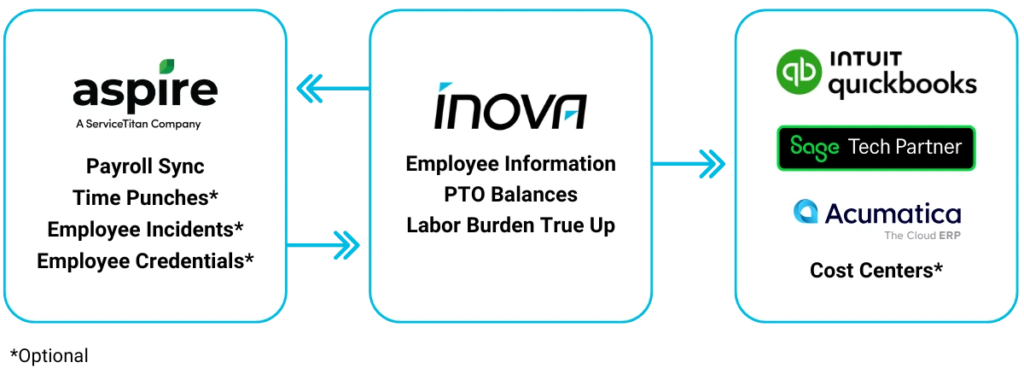
At a high level, this is how job costing and labor data move from Aspire, through payroll, and into accounting systems when platforms are properly integrated.
For teams that want a closer look at how the Aspire payroll integration works in practice, this short walkthrough shows how job data and payroll validation work together.
Because payroll reinforces job-level labor data instead of overwriting it, labor costs stay aligned to the right jobs. Job costing remains intact through payroll processing, audit trails are clearer, and teams spend less time reconciling differences between operations and payroll systems.
Why Payroll and ERP Integrations Still Matter
Strong job costing data alone isn’t enough. Payroll systems need to be able to accept and preserve that level of detail, and then pass it cleanly into accounting and ERP systems.
For Aspire-based organizations, payroll must handle employees working across multiple jobs, split labor accurately without manual workarounds, and scale during peak or seasonal periods. When payroll integrates with ERP or accounting platforms, labor costs flow directly into the general ledger with job-level accuracy instead of being summarized or corrected later.
Payroll systems designed for field-based operations maintain job detail throughout payroll processing and into accounting, strengthening financial accuracy, job profitability reporting, and confidence in labor data across finance and operations.
What Organizations Experience Without Integrated Payroll
Across Aspire-based organizations, similar payroll challenges tend to surface.
Overtime errors occur when employees span multiple jobs. Manual overrides increase during peak season. Job detail can disappear during payroll corrections, creating gaps between operations and finance. Overtime errors and compliance issues are common when employees span multiple jobs, especially when payroll systems can’t consistently preserve job-level labor detail.
These issues aren’t caused by Aspire. They occur when payroll systems can’t consistently handle job-level labor data at scale.
Organizations that address these challenges use payroll systems designed to work alongside operational software like Aspire. Job detail stays intact through payroll processing, overtime rules are applied consistently, and manual corrections decline.
Payroll becomes part of the operational workflow rather than a separate, reactive function.
The Impact Across Teams
When Aspire job costing data flows cleanly into integrated payroll and accounting systems, the benefits extend beyond payroll.
- Finance gains more reliable labor reporting, cleaner general ledger entries, and clearer job profitability insight.
- HR fields fewer payroll disputes and spends less time managing corrections or employee pay questions.
- Operations sees labor costs tied directly to real work, making it easier to understand crew efficiency and job performance.
- Leadership can make staffing, pricing, and growth decisions with greater confidence in the underlying labor data.
Together, integrated job costing, payroll, and ERP systems turn payroll from a recurring pain point into a stable foundation for operational and financial decision-making.