

Considering switching payroll providers while your business is growing? This guide explains why timing matters, what risks to watch for, and how to scale without disruption.
If your payroll system feels stretched, you’re not alone. But before you commit to switching, it’s helpful to quickly assess where the friction is coming from:
- Are payroll errors increasing, or is time tracking the issue?
- Are finance reports delayed because of payroll, or because journal entries aren’t automated?
- Are compliance problems a payroll failure, or the result of growing into new states without the right workflows?
Understanding whether your challenges are caused by the payroll system itself or by the systems around it can save you from a costly and disruptive switch.
Major system changes are harder than they look. In fact, 70% of change programs fail to achieve their goals.
But replacing payroll in the middle of growth can be like changing tires on a moving car. It introduces risk at the exact moment when the business needs stability. Before you pull the plug on your current payroll platform, it’s worth examining what’s really causing friction and what replacing payroll might disrupt.
Why Growing Companies Start Questioning Their Payroll System
It’s common to feel like you’ve outgrown payroll during growth. Payroll starts to feel slow, messy, and disconnected from the rest of the operation. As headcount grows and your operations expand into new states, complexity rises. Pay rules multiply. Compliance requirements shift. Reporting requests become more frequent and more detailed.
Time tracking may not sync cleanly with payroll. Managers may rely on spreadsheets for approvals. HR data may live in one system while payroll operates in another. Finance starts asking for labor cost visibility that your current setup cannot easily provide.
At that point, payroll feels like the bottleneck.
In many cases, though, payroll isn’t failing. It’s operating in isolation. When payroll doesn’t connect cleanly with time tracking, HR systems, and your ERP or accounting platform, visibility drops and manual work increases. Journal entries require adjustments. Reporting slows. Data has to be reconciled across systems.
The frustration shows up in payroll because that’s where compensation is processed, but the root cause often lives in disconnected workflows and fragmented systems.
What Growing Teams Usually Outgrow First (And It’s Not Payroll)
Data quality and integration issues are often the real culprits. Poor data quality alone costs organizations an average of $12.9 million each year.
In reality, payroll is often a scapegoat for broader system challenges. What starts to break during growth is usually the infrastructure around payroll: manual journal entries between payroll and accounting, disconnected time tracking, delayed labor visibility, ERP integration gaps, or reporting that’s no longer fast or accurate enough.
Most growing businesses outgrow the systems around payroll before the platform itself. These often include time tracking tools, manual accounting workflows, and disconnected reporting systems.
When payroll doesn’t integrate cleanly with the systems around it, problems compound. Time tracking data may require manual corrections. Reporting tools may rely on outdated or incomplete information. And when payroll doesn’t connect directly to your ERP or accounting platform, finance teams lose real-time insight into labor costs. Journal entries require manual adjustments. Month-end close slows down.
These aren’t always payroll software problems. They’re integration and workflow problems. Which means the smarter solution may not be replacing payroll. It may be strengthening the systems around it or ensuring your payroll platform is built on a connected foundation from the start.
Platforms designed as unified systems prevent many of these challenges before they surface. When payroll, HR, and time tracking operate within a single database, data flows automatically between modules. That eliminates duplicate entry, reduces reconciliation errors, and ensures reporting reflects a consistent source of truth as your organization grows.
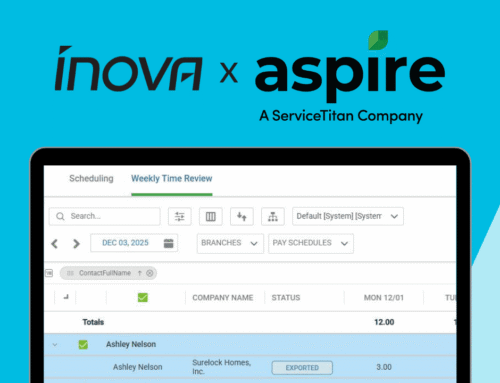
Inova is built on this unified model. Payroll, workforce data, and time tracking operate within the same system, while native integrations with leading accounting and ERP systems such as Sage Intacct, Acumatica, and QuickBooks Online, connect payroll data directly to finance. This enables automated general ledger mapping, streamlined reporting, and real-time labor cost visibility without manual workarounds.
The result is a connected ecosystem that supports operational efficiency and financial accuracy. For organizations already operating within a unified platform, that foundation allows them to scale without disruption. For those evaluating a payroll change, it highlights what to look for in your next solution: a system built to connect time, HR, payroll, and finance from the start.
The Hidden Risks of Replacing Payroll During Growth
Payroll errors are more common than many expect, with one in five containing mistakes that average nearly $300 to fix.
Replacing payroll isn’t like swapping one app for another. It touches every part of your business: HR, finance, compliance, and operations. During growth, when teams are already stretched thin, that disruption can be particularly damaging.
The process of replacing payroll mid-growth often introduces:
- Data migration issues that can disrupt YTD accuracy, such as missing historical earnings, taxes, or benefit deductions that must carry over cleanly to the new system.
- Broken reporting continuity for finance and operations, especially if mid-year data from the old and new systems cannot be easily reconciled, impacting budgeting and forecasting.
- Compliance exposure if payroll filings or benefits deductions fall through the cracks during the switchover, leading to late deposits or errors that can trigger IRS penalties.
- Dual system chaos during transition periods, where teams have to run reports or process adjustments in two places, increasing the likelihood of errors.
- Institutional knowledge loss that impacts efficiency, such as forgetting how custom workflows or deductions were configured in the old system, leading to rebuilds and delays.
These risks are amplified during high-growth phases, when teams are moving quickly and can’t afford disruption.
Financial penalties can also stack up quickly. For example, the IRS assesses Failure to Deposit penalties ranging from 2% to 15% of the unpaid amount, depending on how late the deposit is made.
When Replacing Payroll Actually Makes Sense
There are situations where switching payroll providers is the right move. Typically, they involve structural or strategic change — not just normal operational growing pains.
Here are scenarios where a replacement may make sense:
- A Merger, Acquisition, or Corporate Restructure: Combining entities often requires consolidating payroll systems, harmonizing tax IDs, standardizing pay structures, and unifying reporting. If your current system can’t support the new organizational structure, a transition may be necessary.
- Rapid Multi-State Expansion: Expanding into new states introduces new tax registrations, unemployment insurance rates, local wage laws, and compliance obligations. If your platform struggles to handle multi-state taxation, reciprocity rules, or state-specific reporting requirements, it may be time to evaluate alternatives.
- Transitioning Away from a PEO Model: As headcount grows, PEO administrative fees can become cost-prohibitive. Businesses scaling past 75–100 employees often seek greater system control, customization, and financial transparency than a bundled PEO model allows.
- A Fundamental Workforce Model Shift: Moving toward a contractor-heavy workforce, project-based labor model, or multi-entity structure can strain systems that weren’t designed for that complexity.
- Chronic Compliance Failures: Repeated tax filing errors, missed deposits, or penalties signal structural risk. If compliance issues stem from system limitations rather than internal workflow gaps, replacement may be warranted.
- Lack of Scalability or Technology Limitations: If your payroll platform cannot support multi-state operations, complex pay rules, automation, API integrations, or modern reporting needs, and there’s no upgrade path, it may be time to evaluate alternatives.
- Poor Service or Vendor Instability: Frequent support issues, inconsistent account management, service deterioration after acquisition, or signs of vendor financial instability are valid reasons to reconsider your provider.
- Security or Data Privacy Concerns: If your provider cannot meet evolving data security standards, SOC requirements, or industry-specific compliance needs, risk exposure may outweigh the cost of switching.
Planning for What Comes Next Without Disruption
The good news: You don’t have to choose between stability today and scalability tomorrow.
When payroll operates within an all-in-one human capital management platform, growth becomes far less disruptive. Instead of stitching together separate systems for HR, benefits, time tracking, and workforce management, everything lives in a connected environment designed to expand with you.
With Inova, payroll isn’t a standalone tool. It’s part of a unified foundation. That means:
- One system of record for employee data, eliminating duplicate entry and reconciliation errors.
- Connected workflows between payroll, time, and HR that reduce manual adjustments and mid-cycle surprises.
- Native integrations with leading accounting and ERP systems, enabling automated general ledger mapping, real-time labor cost visibility, and faster month-end close.
- Modular expansion within the same platform, so you can add capabilities as your workforce matures without replacing your core system.
As your organization grows more complex, whether through additional locations, new reporting requirements, or expanded workforce management needs, you don’t need to migrate to a new payroll platform to keep up. You scale within the same ecosystem.
This approach preserves reporting continuity, protects historical data integrity, and minimizes retraining across teams. Finance maintains clean journal entry automation. HR maintains consistent processes. Leadership maintains reliable insight into labor costs and compliance exposure.
Inova gives you control over how and when to scale your HR technology. You invest in what you need today, integrate with the systems that power your business, and expand capabilities over time — without introducing unnecessary risk or operational disruption.
Growth should introduce opportunity, not instability. A scalable, unified payroll foundation ensures your systems evolve at the same pace as your business, without forcing unnecessary disruption.